
This piece was published in the CEU Weekly on March 26, 2016. All images by Colin Forber.
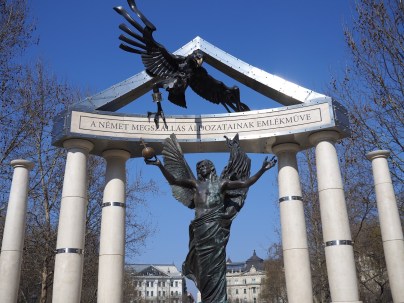 Just after midnight on July 20, 2014, police officers cordoned off Budapest’s Freedom Square, as workers labored under the cover of nightfall. Hours before, a Hungarian court had ruled against a proposed referendum over the construction, which the government declared was “of outstanding importance for Hungary’s economy.” The construction at issue: erecting a monument, symbolizing a past even more dark and complicated than its secretive setup. Now, almost two years later, both the monument and the controversy surrounding it remain.
During World War II, Hungary was a member of the Axis powers, but was occupied by German troops in March 1944 when Germany discovered Hungarian Prime Minister Miklos Kallay had secretly been in talks with the Allies. Kallay was deposed but Admiral Miklos Horthy was permitted to stay on as regent. In May 1944, Hungary began sending Jews to Auschwitz, deporting 424,000 in the first two months alone. As the Axis Powers’ future seemed to grow increasingly grim, Horthy began armistice talks with the Soviet Union, which was quickly approaching the Hungarian border. He was in the final stages of talks when Germany again intervened in October 1944, this time arresting Horthy and replacing him with Ferenc Szalasi, leader of the fascist and antisemitic Arrow Cross party. The Arrow Cross murdered thousands of Jews, organizing death marches to the Austrian border and shooting victims on the banks of the Danube. The latter is memorialized in a privately commissioned 2005 monument, constructed of sixty pairs of cast iron shoes lining the riverbank, not far from Parliament. An estimated 500,000 Jews and 10-12,000 Roma living in Hungary were killed between 1944 and 1945.
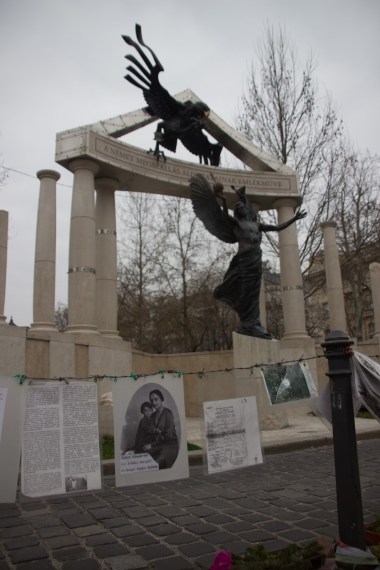
 Unlike the Shoes on the Danube Bank monument, the 1944 monument in Freedom Square, just a few minutes’ walk from CEU, was created by the government to honor the “victims of the German invasion” on March 19, 1944. The Hungarian government declared 2014, the 70th anniversary of the invasion, to be a year of Holocaust remembrance, and the government selected sculptor Peter Parkanyi Raab to create the monument.
CEU History Professor Carsten Wilke explained, “Hungarian historiography and public opinion have faced this embarrassing chapter in the country’s history, and the opening of the Holocaust Memorial Center in 2004 was a dignified way of coming to terms with it. However, as a result of political change, the new constitution of 2011 defined the years 1944-1989 as an interruption of Hungarian statehood, which implied that the Hungarian agents of fascist or communist repression were acting entirely under foreign constraint. The monument erected in 2014 on Freedom Square visualizes this rewriting of the past.”
In the monument, Nazi Germany is symbolized by a menacing eagle, its wings outstretched and talons spread, as it swoops down upon the defenseless archangel Gabriel, representing Hungary. From its conception, the monument was fraught with controversy, not only for its whitewashed depiction of Hungary as an innocent victim of Nazi brutality, but also, according to Wilke, for the “undemocratic way in which the monument had been realized: there was no public competition, the planning was done confidentially, and even the construction took place under cover of the night.”
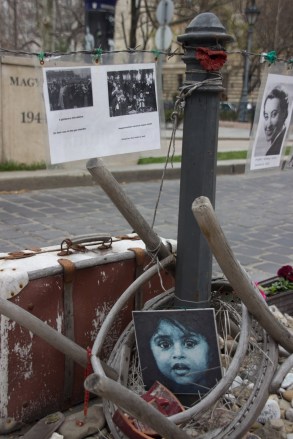
The 1944 monument was never officially inaugurated, and a protest installation, including stones, traditionally left on Jewish graves, and photos of Holocaust victims, was set up in front of it before the monument’s construction was even finished. Jewish organizations cancelled their participation in official government activities marking the 70th anniversary of the deportations, which Wilke observed, “was quite a strong statement.”
However, the Fidesz government and the Jewish community are not always at odds over WWII historical issues. Five years ago, after discovering WWII-era human remains in the Danube River during construction on Margaret Bridge, the government planned to bury them in a municipal site. However, following objections from the Jewish community, the government conducted DNA testing on the bones, which revealed they were likely that of Ashkenazi Jews. Earlier this year, Budapest’s Jewish community successfully lobbied to bury the bones in a Jewish ceremony held in Budapest’s main Jewish cemetery on March 20.
“This is an important indicator of consideration, and there are others, regarding especially the protection of the splendid but decaying cultural heritage of Hungarian Jewry,” noted Wilke. “The Fidesz government is often unjustly suspected of antisemitism by foreign media; a cooperation in good faith with the Hungarian Jewish organizations is therefore a source of prestige. High-ranking politicians participate in Jewish events, and this is reported on Hungarian state TV at prime time. Yet it was suspected that the breach between the state and the Jewish community before the commemorative ceremonies in 2014 may have been in the interest of both sides, as there was no commonly shared view of the 1944 persecutions.”
 The controversy around Hungary’s portrayal of its history did not end with the 1944 monument. The government’s proposed “House of Fates,” a Holocaust museum that critics argued would present a skewed version of the Holocaust in Hungary (and whose funds Jewish community organizations have contended would be better spent on the existing Holocaust Memorial Center), has been significantly delayed from its originally scheduled 2014 opening. Last month, a bust of Gyorgy Donath, a Horthy-era Hungarian politician, was installed a block away from the Budapest Holocaust Memorial Center, though the unveiling ceremony was cancelled after significant protest. Shortly after its installation, the bust was removed due to concerns of vandalism. In December, plans to install a statue for another WWII politician, Balint Homan, in the city of Szekesfehervar, were cancelled following condemnation from Hungarian Jewish groups and the US Special Envoy to Monitor and Combat Anti-Semitism.
These disputes, according to Wilke, “show that the German Occupation Memorial has not been successful in spreading its message: the years of 1920-1945, in which antisemitism was inscribed in Hungarian law, have not been whitewashed en bloc, but the memory of each and every personality of those times is still to be judged individually. These debates may seem repetitive, but they are necessary, and they show that the image of the interwar period and its major actors has maintained its complexity.”

 Ilana Ullman